4 of 7 – Bisexual Epistemologies: A Journey from Nausea to Commitment

Bisexual Epistemologies: A Journey from Nausea to Commitment 
An occasional piece by
Serena Anderlini-D’Onofrio, PhD
For The Journal of Bisexuality’s 10th Anniversary Issue
Hi dear readers!
This seven-in-one piece will be great fun–yours truly promises.  Find out all the ins and outs of 10 years of Bisexuality!  What does “epistemology”mean?  Big word, right?  Well, all it means is that when you’re making love you’re producing knowledge.  A good thing!
We follow The Journey with Klein’s Option and Other Classics, and will have three more posts.  Really revealing of all those things about bi you’ve always been curious about.  Why is it so good?  What can it do for you?  For the planet?  For the future?  For authentic intimacy?  It’s all here, spiced with a bit of irony and critique of why we’re so behind on our agenda.  What’s keeping us from being more efficient.
Also arcane words you’ve been told have no meaning unless you got a PhD are explained–made very easy!  “Nausea,” “existentialism”: it’s all about the chakra system–really.  Commitment?  It’s not about going to jail (as in, “being committed”).  But rather, it’s about “being-in-action” about things.  Being the one who makes the difference!  No mysteries.  Woooooow!  Come back for more, will you?  We’ll post every week, on Tuesdays.
Namaste,
Serena
4. Klein’s Option and Other Classics
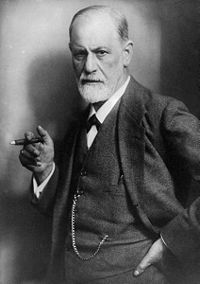
Sigmund Freud
Speaking of classics, many were of course in the back of Fritz’s mind when he wrote the book.  One is Freud’s “On Femininity,” an essay of 1933 often simplified to a diagnosis of “penis envy” for women.[1]  Women, explains Freud, have a more difficult time adjusting to adult normativity in a homophobic social order because it requires giving up the gender of one’s first object of erotic desire, the mother, and the first site of female self-pleasure, the clit.  That’s why, I observe with my students when we read it in the class on practices of love in Western cultures and traditions, if you follow the logic of Freud’s argument, in a social order where homophobia has disappeared, you’d have to prescribe bisexuality as a path to healthy development for all women.  But Freud of course could not recommend what Fritz wished for all healthy bisexuals, “100 percent intimacy,” or else he would have been fired and accused of the very same “perversion” he was trying to cure.  “When one gets into action there comes commitment, and thereby freedom appears, in Fromm’s sense of being free,” recites the existential litany.  I am a woman, and when I was younger, in the age of fertility, I used to think that existentialist dilemmas were a peculiarity of masculinity.  Women don’t wonder about the meaning of existence.  We simply make the effort of existing relationally and in communion with other beings.  “That must be why I’m so confused,” I mused.  My inner landscape was still not settled enough to begin, especially the solar plexus and heart chakra regions.  “The age of wisdom must bring existential dilemmas to women too,” I concluded. 
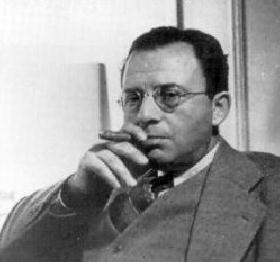
Erich Fromm
I knew Fritz.  I was familiar with his playful, carnivalesque, iconic persona at play parties of the bisexual community, with his symbolic presence and significance at the Bisexual Forum meetings.  I have anxiety of influence and so it is difficult for me to muster the humility to really surrender to the aural force of iconic figures.  Much to my own damage sometimes, I often tend to resist it.   But it’s also a self-preservation skill that evaporates when I read them.  I had read The Bisexual Option in the early days as part of the San Diego bisexual community.  And I remember being struck by its insightfulness, clarity, complexity, simplicity, authenticity, erudition, accessibility, and realism.  These qualities are not easily found in one book!
Solitude, community, I said.  What did Fritz say about it?  Freud believed that the body of the mother is what we all fall in love with since infancy.  Eros, the energy of love, is activated as soon as we exit the womb.  For Reich, this happens even before we do, and in fact, we all long to go back in to cozy and protected pre-natal existence wrapped into our mom’s placenta and amniotic liquid.[2]  Yes, loving the mother is what we really want to do, like Oedipus, who managed to marry her too and re-enter the birth channel with his penis.  Further, for Freud taboos exist because otherwise we would all do what’s forbidden.  Wooooooow!  When I read Klein, in the early 1990s, I was not sure about all this.  His theoretical framework did not go back that far, and was actually founded on the Kinsey scale, the result of quantitative studies done in the post World War II period.[3]  Klein utilized this scale to estimate the bisexual population in the United States at 25-30 million (1993, 11).  He developed the Kinsey scale into the Klein Sexual Orientation Grid (KSOG) to get past mere sexual behavior and into future, ideal, and fantasy, as ways to assess bisexuality as the potential to be intimate, sexual, and loving with people of all genders (1993, 17- 22).  Yes, fantasy counted for Fritz, as a way to assess one’s potential for sexual expression and emotional intimacy.  Obviously, with the Klein Grid, almost everyone would qualify as potentially bi.  Who hasn’t had a same-sex erotic fantasy at least once?  But where could this potential be actualized in a world where the practice of love was organized around the homo/hetero divide?  What was missing for bisexuals in Klein’s mind at the time he wrote the book, in early 1980s?  Bisexuals, Klein observed, were in a “limbo” (117), and when asking himself what was needed to exit the limbo, his answer was clear: “a valid sense of identity, of community” (117).
So I went back to my own work with The Journal of Bisexuality, the four issues I’ve guest edited over eight years, seeking a connectedness, a link to what had inspired me to embrace this community–and be hugged back profusely–in those early years as a solo female immigrant from the European Union to the United States.
What had moved me?  What still resonated with me?  Had I been seduced to embrace something that ultimately rejected me–that betrayed me–that ignored and misunderstood the depth and complexity of the inner landscape of my existence?  Or was it that the community itself offered an oasis of sexual fluidity and amorous inclusiveness where love could be practiced without fear?
If we agree with Klein that almost everyone has the potential to be bisexual, and that only some people are fortunate enough to actualize this potential, this applies even more clearly to those infants who are born of the same gender as one’s mother.  How can a woman love and find intimacy if the whole gender of her first love object is forbidden?  How can she experience pleasure if the first site of pleasure she discovers in her body as an infant is ignored in the staple sexual act she’s supposed to submit to, the famous “missionary position”?  Klein’s realism comes when he gets to “adjustment,” which in Freud is another word for repression.  In Freud’s discourse, repression of same-gender desire and of clitoral pleasure are the way to become a well-adjusted, psychologically medicated, middle-class wife in Vienna’s well-to-do society, and “penis envy” is the side effect of this adjustment.  But for Fritz Klein repression should be minimized to obtain what he calls “healthy bisexuality.”  A healthy bisexual is capable of 100 percent intimacy because s/he is not afraid to love, be intimate with, and be aroused around people of any gender (1993, 29-37).  This resonates with Jiddu Krisnamurti’s wisdom that “it is no measure of health to be well-adjusted to a profoundly sick society.”
According to Klein, therefore, the task at hand is not “adjusting individuals” but rather changing society to where it can accept them for what they are.  That’s why he founded Bisexual Forums in New York and then San Diego, where I joined in under the coordination of Regina Reinhardt, and then under my own with another non-partnered female participant. 
Now I realize what Forum means.  Not a support group.  Not a social meet-up group.  Not an advocacy group.  But a “forum”: a place to discuss what a culture that values bisexuality as a virtue looks like, feels like, smells like, tastes like–what it is like to get one’s life organized around it.  In the San Diego years (1991-1997, narrated Eros, my memoir of that period), the experience of that–and what I learned–has guided my efforts and dedication to the guest-edited issues in the subsequent years in Puerto Rico.
What is, in retrospect, the wisdom of those years?  That bisexuality needs to be treated as a holographic research trope to be studied in all possible contexts and from all possible perspectives.  The Journal of Bisexuality has fulfilled this mission in these past ten years, with many valuable contributions from multiple authors, guest editors, and editors.  It has been a blessing to have this Journal around because it has provided a haven from other models of research that are far less visionary.  For example, in the AIDS era, the medical model of research has operated on a mode that inevitably pathologizes bisexuality, not because there is anything unhealthy about bisexuality, but because–prevalently in the US but also well beyond its precincts–medical research today is slave to the greed of Big Pharma, with doctors and medical researchers reduced to salesmen of products from the pharmaceutical industry–what the Greeks called pharmakon, a word that in the wisdom of that ancient language also meant poison.[4]  This model of research on bisexuality is a complete betrayal of the legacy of Fritz Klein because he claimed that bisexuality is healthier than any monosexuality as it involves “100 percent intimacy.”


[1] The essay appeared in English in the Hogarth Press standard edition of 1964. 
[2] My references are Wilhelm Reich: Character Analysis (1980), and The Function of the Orgasm: Discovery of the Orgone (1986).
[3] My references are Alfred Kinsey: Sexual Behavior in the Human Male (1948) and Sexual Behavior in the Human Female (1953).
[4] My sources are a whole spate of new books on the theme: The Deadly Dinner Party (2011), The Hundred-Year Lie (2007), Side Effects (2008), and Our Daily Meds (2009).


#  #  #  #  #  #  #  #  #
Yours truly appreciates your attention.  Stay tuned for more wonders.

Namaste,

Serena Anderlini-D’Onofrio, PhD

Gilf Gaia Extraordinaire
Author of Gaia and the New Politics of Love and many other books
Professor of Humanities

University of Puerto Rico, Mayaguez

Join Our Mailing List
 GaiaCoverFullSize  
Follow us in the social media
Poly Planet GAIA Blog: http://polyplanet.blogspot.com/ 
Author’s Page/Lists all books: http://www.amazon.com/-/e/B001JS1VKA 
YouTube Uploaded Videos: http://www.youtube.com/SerenaAnderlini
 

Find us on FacebookFollow us on TwitterView our profile on LinkedInView our videos on YouTubeVisit our blog

Join Our Mailing List

http://polyplanet.blogspot.com

3 | Friday is for Poetry | Venerdi Poesia | “A Lake for the Heart | Il lago del cuore” | Luigi Anderlini

Hi lovely Earthlings!
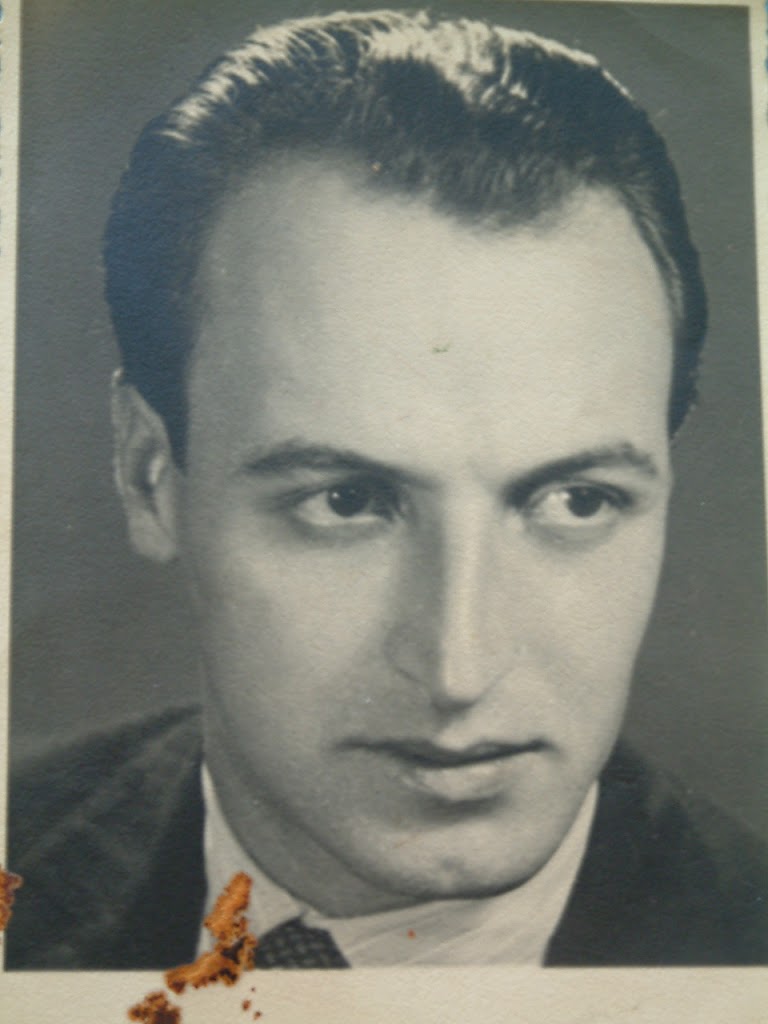
And here we come to the third episode of Friday is for Poetry, where yours truly introduces you to her dad’s love life, “Women,” a beautiful tapestry of many intersecting loves.  Luigi Anderlini always was handsome with the beauty of intelligence and the courage of hope.  But he was shy as young man.  Not a Don Giovanni at all!  He became a widower at the age of 46 as a senator in a country with no legal divorce, or at least, a very young divorce law that nobody knew how to practice yet.  No wonder there was that constant buzz around him of women, hopefuls, waiting to find out who the most papabile was, the next one to be made pope.  Luigi was always diligent, he didn’t make promises, he sometimes ran into trouble, and was not very capable of or trained in discussing his love life openly with his kids, us.  partly it was the legacy of Catholicism, a religion he had repudiated, to imply that widowhood was the end of love.  Partly it was the very indecisiveness of the situation: was he going to form a new, blended family, find a companion for his later years, or both?  Partly it was the difficulty of assessing the loss of his first wife, your truly’s mom, and the lack of attention that caused it as the family failed to see what was coming upon her.  Be that as it may, Luigi remembered his initiations into the practice of love, his everlasting desire to be a source of this magical energy as his life unfolded, and the women whose mark on his soul was most significant.  
As in the poem, so in life, Luigi Anderlini dreamed of women in his life who got along.  His is a dream of inclusive love.  
The occasion is also hospitable to sharing family images that yours truly hopes you will enjoy. 
 
WOMEN
“joy
that you all modestly bestow on earth”
Foscolo –  “The Graces”

                                              I still remember your warm hand
                                              Searching, impatient, as it opens up my fly.
                                              Your mysterious black shrub
                                              And your sweet invitation, “come on in!”
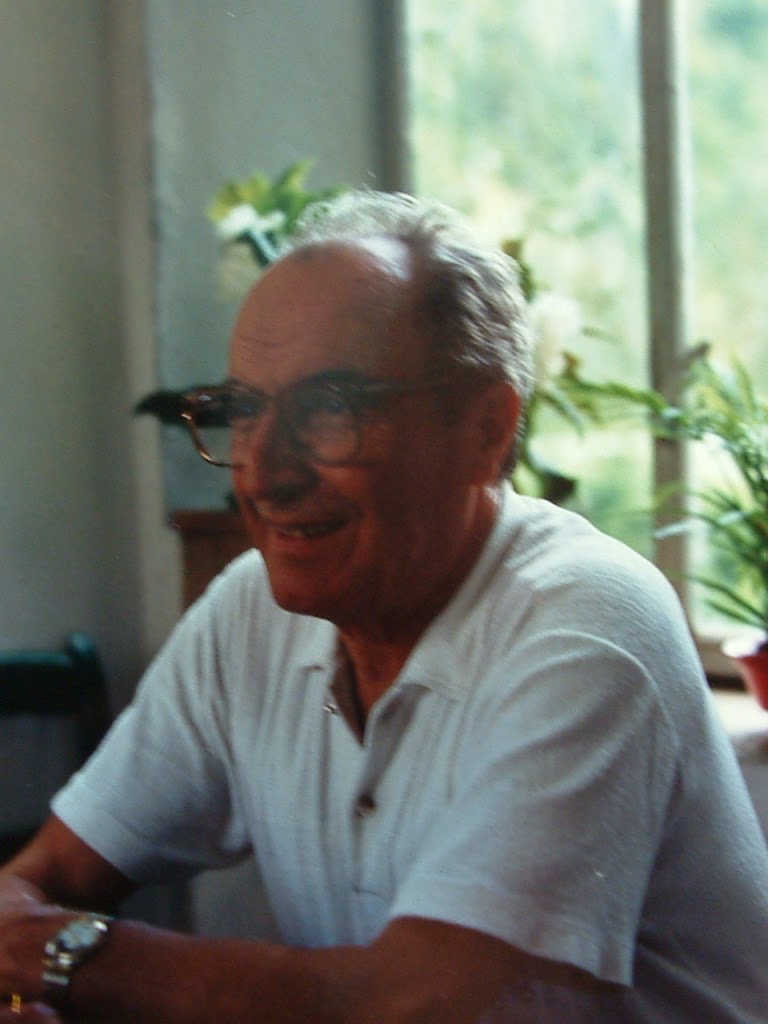
Luigi Anderlini at 21 or so
Tender milk the white of your skin,
Soft the round of your breast,
And unexpected the warmth of your sex.
You smile, hold me, and breathless
You almost cry from joy.  Then happy
You smack a kiss on my forehead.
I’m still looking for it among my wrinkles
Because that hot kiss is still there,
Last gift of my adolescence.
Nobody was expecting you.  We only
Knew your first name, Federica.
You arrived in the fall when the persimmon
Leaves had bared the tree’s branches
And the red fruits glowed in the sunset.
I fell desperately in love with you,
Beautiful cousin with wide gray eyes.
I sweated, I paled, I clammed up
As you displayed the unusual red
                                                 Of your lips next to the fruits.
                                                 Since then I’ve know that love breaks out
                                                 Suddenly, with no respite:
                                                 A pain piled deep in your chest
                                                 That makes your days feel light
                                                 And lifts you to the sky like a dragon-fly.
The room was cold.  An oilskin
Covered half of your red bed
To protect if from a boot’s mud.
You lay down, indifferent, accessible
Playing with your teddy bear,
With circles deep under your shiny eyes.
Throbbing, I land on top of you
– “Good for you” – you say – “You’re done.”
I quickly button up.  I pay and get out.
Resentful, I tell myself – “I won’t do this again” –
But I know this won’t be true.
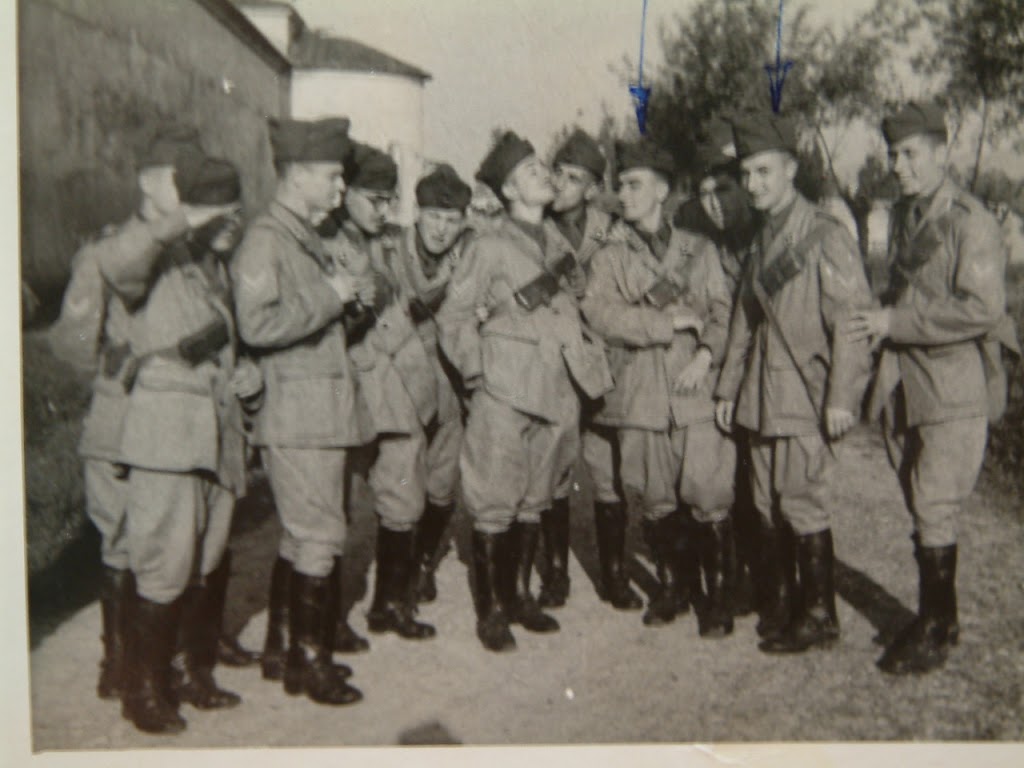
Anderlini is second from right, World War II
On the Florence train while the war raged on,
You fell in love with my uniform,
With my youth, sad and muddled.
I read your trade in your eyes.
We went to Citerea and spent three days
In a world of our own.  For three nights,
My barracks and your brothel,
Your humiliations and my war
Did not enter the closed husk
Where we, stunned, affirmed  
Our right to be happy.
With your watery, dilated eyes
On the bed unmade, you persuaded me
That I was nothing but an invading
Soldier to your country in war.
Your lifeless smile, your tight lips
Persuaded me that love’s games
Do not thrive on conflict or scarcity.
You left crying and on the night table
I found the meager gifts with which
I had tried to apologize to you.
I was left alone, disappointed about
Myself, the world, and the war.
You and I got drunk on spring air. 
The war was over.  We discovered
The swelling river loops of the Velino,
A lake’s throbbing mirror, and the sunny
Afternoon light in the summer;
Your girlfriends in the nude, who,
Unexpectedly, camouflaged to excite us.
Since then, your name, Albertine, has been
A sweet mass on my anxious heart. 
Rolling hills to the vanishing point, while
In the sunset we descend from the mountain top.
Big tits that surround the valley
Of a blue green dappled in pale ochre.
Suddenly you evaporate upon the hills,
You, enormous, lie inside those curves,
Wrapped around them, swollen, expanded.
When you come back to us, your hip
Is the short arch of a curvy circle.
My desire burns with the sunset fire,
Happy and full of light.
She was very short and dark, Maria
And she liked to take long walks,
Affectionate and chatty.
She loved the sunset lights.
She knew where she was going: she’d get
On top of a gray boulder and laugh.
Tall over me, she’d let go and
Kneeled to kiss me, complacent.
When she leaned against the boulder
She was ready for a sweeping fuck.
We’d read Montale’s poems together,
With Ungaretti’s and Quasimodo’s lines.
The charm of Hermeticism got a hold of us.
We realized the best thing was brushing
Our tops against each other, like palms,
And leave the smell of the roots for another time.
A sudden fancy enthralled the two of us
Then you got lost in the gray crowd.
When in bed you expected lewd words.
But your soft oval curves bewitched me,
With your swelling boobs, and the wonderful
Shape of your buttocks.  I would have rather
Yelled to you the pale pink
Beauty of your sweet ellipses;
But you did insist on the lewd calls.   
“I really like my husband” Algisa
Often said, laughing.  Affectionate,
She made sure I knew
With her I risked nothing.
It was just a beautiful game between us.
She brought up that connection over and over
And with her mind elsewhere
Our rendez-vous acquired a special taste.
They provided the evidence that life
Is much richer and complex than any logic.
Love is a blissful inconsistency
Of feelings, guilt, and jealousy.
In Mogadishu your black skin shines.
Over the sea a white-blue sky,
And on the beach a hundred somersaults for us.
Your voice beguiled me, Carla.
You, in the pit, locked in the translator’s cabin;
With your borrowed voice I spoke to others,
And inevitably we were tied up. 
Beijing, China.  A river island
And the Chinese mystery of a
Language in songs and ideograms.
You spoke Danish like Hamlet.
Tangle of unintelligible words!
Past the wall, happy, you laughed
At me dealing with the dictionary.
To speak with you I draw two lips,
A heart and an arrow, a shell;
I transcribe the notes of a nocturne;
Sol mi, re mi re, do sol. 
Enchanted, almost wordless night,
With a billion Chinese all around us.
***
A procession of you steps out
Of the past, and I meet you all
In the hallway of your whore-house. 
You are a crowd that whispers and laughs.
The madam is gone but her voice
Still echoes around: “Spineless guys!
You jerk up too much!  Get upstairs!”
I search your eyes one by one.
But gone from your face is the
Professional gaze of the harlot.
Here are Marina’s green eyes:
No longer a provoking challenge,
They show a tender and cold light.
And Minni’s humongous tits,
Once a generous proposition,
Now a soft, maternal cushion.
There are Carla’s lips;
A dazzling offer now turned into
Respectable red lacquer.
Lola’s swelling curves, once
The promise of a lewd fuck,
Now an impish game, harmless. 
Faces parade that I don’t recognize,
Women I met only once
Groping for a rapport
That wouldn’t be just fucking,
Trying to get to know each other
And find common ground.
***
The crowd disperses.  I am left alone
And surprised I declaim a line
That has been buzzing my soul for a while:
“Three women came around my heart.”
One summer afternoon
Anna broke into the circle.
On the Spanish Steps the sun inserted
Golden straws in the green of her eyes,
and I got lost in the soft flow of colors,
standing in front of Rome’s crimson dusk.
It was a brief season, for at twenty
You can still play hide-and-seek
With love, wounds heal in a flash.
And she left for far away lands:
An adventure that eventually gave her
Children and maturity.  Ten years later
She came back disillusioned. 
Suddenly the dormant coals revived,
The new days drenched in the old flavor.
Tenacious, she went back to dig her furrow
In the large meadow of life,
Up to our days, serene, sad
Humble yet alive, as old age
And habit require.
Lidia and Luigi in Paris, on honeymoon, 1952
Lydia was instead
A mature choice, and irrevocable;
A confident giving oneself for life;
A precise desire to blossom in our children,
In the entwining of our two lives
To share our blood with other lives
Like two separate wisterias
That interlace their branches in the garden.
And for fourteen years it was like that:
Love baked like bread,
In the generous heat of the oven.   
She had decided to marry me
Almost too rationally (“an experiment” she called it).
Yet she fell happily in love with her husband
And with her I so dazzled
Like one lost in a sweet labyrinth.
Days of long reveries paced by the beat
Of our twin hearts. 
Then life’s fury engulfs us:
The kids, my political career, your school.
I become mayor of Narni.  TV school hires you.
Serena is born.  I get into Congress.
Life gets full of spice, like a soccer game
Where we win, playing as a couple,
And all defenses are routed out.
Luca is our happiness for another life.
Politics fills our every moment
But Quasimodo still tempts us, Visconti
And Brecht intrigue us, Calvino seduces us.
Then the tragedy explodes, sudden.
Almost one year of anxiety as a tumor
Convulses your bowels. 
It’s the end for you, in a mode of everyday life;
the bitter, piercing cut of our separation,
The goodbye with no return. 
Since then you’ve been sitting in the cold,
alone under the hill.  The bloodstained
Furrow of your life has been left half done. 
The years we’ve lived together lay deep
In my tired but unbeaten heart.
Luigi at a Golden Doves for Peace event
And you, Colomba, arrive when ochres,
Reds, and yellows have already tarnished
The green of my garden.
On the horizon that is opening up
Your sweet image has been growing for a while.
The garden opens up again at your smile.
In the winter, camellias bloom again
In my expanded heart,
And my feelings are again in flower.
Then springs comes back, all of a sudden:
Large bunches of broom flowers
In our room at Vicolo del Giglio;
your colorful thread and sharp needle
(barely flashing between you fingers)
doodle a string of griffins on the fabric.
New friends warm up our lives.
Your surrender is new and sweet every time:
An embrace, forlorn and supple.
And your tenderness is a nice pillow
Where I rest my bitter thoughts.
You are paving my difficult path
To the nameless nothing.
When death arrives, I hope
It has your dry, smiling eyes.
I know that at times my three circles of love
Have almost overlapped. 
They look like the Greek sign
That the Olympic Games are played under.
Sometimes the aftertaste of these complicated
Entwinements is bitter in one’s mouth;
Wonderful, demanding, unique,
Like the story of any human life.
***
And now, women, you are all here
In these lines, beautiful and impalpable.
You are one half of this sky and other ones.
Life on the planet bears your sign,
It pours from you like water from the fountain
And it crosses, transparent, the large meadow
Where any adventure blossoms and dies.

Donne
“gioia
che vereconde voi date alla terra”
Foscolo – “Le Grazie
Ricordo ancora la tua mano calda
che mi fruga impaziente e mi sbottona.
Quella tua misteriosa macchia nera
e l’invito dolcissimo: – “Su, vieni!”.
Tenero latte il bianco della pelle,
morbidissimo il tondo del tuo seno
ed insperato il caldo del tuo sesso.
Tu sorridi, mi stringi ed in affanno
quasi gridi di gioia; poi felice
mi stampi un bacio a schiocco sulla fronte.
Io me lo cerco ancora tra le rughe
perché è rimasto li – caldo – quel bacio:
ultimo dono dell’adolescenza.
Nessuno t’aspettava. Sapevamo
di te soltanto il nome: Federica.
Arrivasti d’autunno che le foglie
spogliato aveano nel giardino il cachi
e i frutti rosseggiavano al tramonto.
Mi innamorai di te perdutamente,
bella cugina dagli occhioni grigi.
Sudai, sbiancai, ammutolii sconvolto
dal rosso inusitato delle labbra
che esponevi al confronto con i frutti.
Da allora so che amore si scatena
all’improvviso, senza darti scampo:
una pena ammassata in fondo al petto
che pure fa leggere le giornate
e in ciel ti libra come una libellula.
Fredda la stanza. La tela cerata
ricopriva a metà il letto rosso
a difesa del fango delle scarpe.
Sdraiata, indifferente, disponibile
giocherellavi con il tuo orsacchiotto,
troppo affossati i lucidi occhi neri.
Ansimante finii sopra di te
– “Sei proprio bravo” – dici – “Hai già finito”.
Mi riabbottono in fretta. Pago. Esco.
Mi dico astioso – “Non lo farò più” –
anche se so che non sarà mai vero.
Sul treno per Firenze, in piena guerra,
ti innamorasti della mia divisa,
dei miei vent’anni, tristi e scombinati.
Io ti lessi negli occhi il tuo “mestiere”.
Partimmo per Citera e per tre giorni
fummo fuori dal mondo; e per tre notti
la mia caserma e la tua “casa chiusa”,
le tue umiliazioni e la mia guerra
non scalfirono il guscio sigillato
entro il quale, storditi, proclamammo
nostro il diritto d’essere felici.
Con l’acqua dei tuoi occhi dilatati
mi convincesti sul quel letto sfatto
che io altro non ero che il soldato
che aveva invaso in guerra il tuo paese.
Quel tuo sorriso spento, a labbra strette
mi convinse che il gioco dell’amore
mal sopporta i conflitti e la miseria.
Te ne andasti piangendo e mi lasciasti
sul comodino i poveri regali
coi quali avevo tentato di scusarmi.
Solo mi ritrovai, solo e deluso
di me, del mondo intero e della guerra.
Ci ubriacavamo d’aria a primavera.
La guerra era finita. Scoprivamo
le anse gonfie d’acqua del Velino,
lo specchio trepido di lago e luce
nei meriggi assolati dell’estate,
il nudo inaspettato delle amiche
che in costume giocavano a eccitarci.
È da allora, Albertina, che il tuo nome
sul mio cuore affannato è un dolce peso.
Colline morbide al tramonto in fuga
mentre insieme scendiamo dalla vetta.
Intorno alla pianura mammelloni
verde-azzurro, striati d’ocra pallido.
Tu a un tratto evapori sulle colline,
distesa, enorme, dentro quelle curve
tonde avvolgenti gonfie e dilatate.
Quando torni tra noi su quel tuo fianco
– arco breve d’un cerchio sinuoso –
si brucia il desiderio mio nel fuoco
d’un tramonto felice e tutta luce.
Piccolina, nerissima, Maria
aveva il gusto delle passeggiate
affettuose lunghe e discorsive.
Amava assai le luci del crepuscolo.
Aveva la sua mèta: un sasso grigio
sopra il quale saliva sorridendo.
Alta sul sasso, si lasciava andare,
si chinava a baciarmi compiaciuta.
Se si appoggiava all’albero era segno
ch’era pronta a un amplesso travolgente.
Leggemmo insieme i versi di Montale,
le poesie di Ungaretti e di Quasimodo.
Ci vinse la malia dell’ermetismo.
Ci convincemmo che come le palme
era meglio sfiorarsi per le cime
ignorando l’afror delle radici.
Un capriccio ci avvinse all’improvviso
poi ti perdesti, grigia, nella folla.
Volevi a letto, tu, parole oscene
ma io ero ammaliato dalle curve
morbide, ovali, gonfie del tuo seno,
dalle forme stupende delle natiche.
Gridarti avrei voluto la bellezza
delle tue dolci ellissi in rosa pallido.
Tu preferivi invece frasi oscene.
Amava molto suo marito Algisa.
Lo ripeteva spesso sorridendo.
Voleva farmi certo – affettuosa –
che con lei non correvo rischio alcuno
e che il nostro era solo un gran bel gioco.
Quel legame più volte ribadito
e quel sentirla col pensiero altrove
davano un gran sapore ai nostri incontri.
Fornivano la prova che la vita
è più ricca e complessa d’ogni logica,
che l’amore è felice incoerenza
di sentimenti, colpe e gelosie.
Lucida pelle nera a Mogadiscio.
Bianco-azzurro del cielo sopra il mare
e sulla spiaggia cento capriole.
Fu la tua voce, Carla, a circuirmi.
Tu, in fondo, chiusa nella tua cabina;
io che parlavo agli altri con la voce
che mi imprestavi: vincolo, spessore
per un rapporto forte e ineludibile.
Cina-Pechino. L’isola sul fiume
e il mistero cinese d’una lingua
quasi cantata e per ideogrammi.
Ti esprimevi in danese come Amleto.
Garbuglio di parole incomprensibili!
Di là dal muro tu lieta ridevi
di me alle prese con vocabolario.
Per parlarti ti disegno due labbra,
un cuore ed una freccia, una conchiglia;
ti trascrivo le note d’un notturno:
sol mi, re mi re, do sol. Fu una notte
incantata, quasi senza parole
con attorno un miliardo di cinesi.
***
Vi vedo uscire in fila dal passato
e vi ritrovo tutte nel “salone
d’ingresso” della vostra “casa chiusa”.
Siete una folla che bisbiglia e ride.
La “maitresse” non c’è ma la sua voce
stagna ancora nell’aria: – “Smidollati!
Vi fate troppe seghe! Andate in camera!”
Io vi scruto negli occhi ad una ad una.
Nei vostri volti non c’è più il sorriso
professionale della meretrice.
Eccoli gli occhi verdi di Marina:
non sono più una sfida provocante,
hanno una loro luce fredda e tenera.
E quelle tette enormi della Mìnni
non sono una proposta generosa.
Sono un cuscino soffice e materno.
Eccole lì le labbra della Carla;
una offerta che allora ti stordiva.
Ora un bel rosso lacca rispettabile.
Le curve gonfie e morbide di Lola
non promettono più l’amplesso osceno,
ma un gioco malizioso ed innocente.
Sfilano volti che non riconosco,
di quelle che incontrai solo una volta
e con le quali ricercai un rapporto
che non fosse soltanto freddo amplesso
ma sempre un tentativo di conoscersi,
di scoprire comuni le radici.
***
Il salone si sfolla. Resto solo
e mi sorprendo a recitare un verso
che mi ronza nell’animo da tempo:
“Tre donne intorno al cor mi son venute”.
Anna irruppe nel cerchio un pomeriggio,
d’estate a Trinità dei Monti: il sole
inseriva pagliuzze d’oro pallido
nel verde dei suoi occhi: io mi perdei
nel morbido fluire dei colori,
davanti a Roma rosa nel tramonto.
Fu una breve stagione ché ai vent’anni
si gioca a rimpiattino con l’amore,
le ferite guariscono in un lampo.
E lei partì per terre assai lontane:
un’avventura che doveva dargli
figli e maturità. Dopo dieci anni
disillusa tornò. L’antica brace
si ravvivò ad un tratto, le giornate
di nuovo intrise del sapore antico.
Lei tenace tornò a scavare il solco
nel grande prato, fino a nostri giorni
sereni, tristi, poveri ma vivi
così come comandano vecchiaia
ed abitudine.
Lidia fu invece
una scelta matura e irreversibile,
un confidente darsi per la vita,
una voglia precisa di fiorire
nei figli, l’intrecciarsi di due vite
per altre vite nel comune sangue
come talvolta intrecciano in giardino
due glicini diversi i loro rami.
E per quattordici anni fu così:
crebbe l’amore come cresce il pane
nel caldo generoso della madia.
Lei che aveva deciso il matrimonio
quasi a freddo (“esperimento” – disse)
s’innamorò felice del marito
ed io di lei tanto storditamente
quasi perso in un dolce labirinto.
Lunghe giornate trasognate: il ritmo
era quello del battito del cuore.
Poi la vita s’infuria e ti travolge:
i figli, la politica, la scuola.
Sindaco a Narni. Tu a telescuola.
Nasce Serena. Arrivo in parlamento.
La vita si fa piena e il gusto forte
di viverla in coppia vince e sfonda
come talvolta capita allo stadio
che sbaraglino in due ogni difesa
Luca è felicità d’un’altra vita.
La politica impegna ogni momento
ma ci tenta Quasimodo, ci intrigano
Visconti e Brecht, ci seduce Calvino.
Poi la tragedia scoppia all’improvviso.
Quasi un anno d’angoscia col tumore
che sconvolge le viscere. La fine
vista con gli occhi d’ogni giorno, il taglio
amaro e lancinante del distacco,
l’addio senza ritorno. Tu da allora
sei sola al freddo, sotto la collina.
È rimasto a metà – insanguinato –
il solco. Gli anni che vivemmo insieme
sono come adagiati – ora – sul fondo
d’un cuore affaticato ma non vinto.
E tu, Colomba, arrivi quando l’ocra,
il rosso e il giallo inquinano il giardino.
Sull’orizzonte che si va schiudendo
cresce da tempo – dolce – la tua immagine.
Sorridente riapri tu il giardino.
Nel cuore che s’allaga, le camelie
fioriscono di nuovo in pieno inverno
e tornano a sbocciare i sentimenti.
Poi a un tratto è di nuovo primavera:
gran fasci di ginestre nella stanza
di Vicolo del giglio; quella serie di grifoni
che il filo colorato e l’ago aguzzo
(ti balena appena tra le dita)
sciolgono in ghirigori sulla tela.
Nuovi amici ci scaldano la vita.
Nuova ogni volta e dolce è la tua resa:
un abbraccio smarrito e flessuoso.
E la tua tenerezza è un bel cuscino
in cui distendo amari i miei pensieri.
Stai spianando per me la via difficile
che porta al nulla senza nome.
Quando arriverà la morte, io spero
Abbia i tuoi occhi asciutti e sorridenti
Lo so che i miei tre cerchi dell’amore
si sono a volte quasi sovrapposti.
Somigliano a quel simbolo sportivo
sotto il quale si celebrano “i giochi”.
Un intreccio di vite complicato,
che lascia a volte molto amaro in bocca,
stupendo, faticoso e irrepetibile
com’è la storia d’ogni vita umana.
***
E adesso, donne siete tutte qui
in questi versi, belle ed impalpabili.
Siete metà di questo e d’altri cieli.
La vita sul pianeta ha il vostro segno,
scende da voi come acqua dalla fonte
e limpida attraversa il grande prato
dove fiorisce e muore ogni avventura.
1999

Did you enjoy the poem?  Let us know!  Yours truly appreciates your attention.  The comments box is open.

The poems will appear every Friday at 11:00 AM.  Come back!  And get your copy of A Lake for the Heart right away!

Stay tuned for more wonders.

Namaste,

Serena Anderlini-D’Onofrio, PhD

Gilf Gaia Extraordinaire
Author of Gaia and the New Politics of Love and many other books
Professor of Humanities

University of Puerto Rico, Mayaguez

Join Our Mailing List
 GaiaCoverFullSize  
Follow us in the social media
Poly Planet GAIA Blog: http://polyplanet.blogspot.com/ 
Author’s Page/Lists all books: http://www.amazon.com/-/e/B001JS1VKA 
YouTube Uploaded Videos: http://www.youtube.com/SerenaAnderlini
 

Find us on FacebookFollow us on TwitterView our profile on LinkedInView our videos on YouTubeVisit our blog

Join Our Mailing List

A Lake for the Heart

http://polyplanet.blogspot.com
3 of 7 – Bisexual Epistemologies: A Journey from Nausea to Commitment

Bisexual Epistemologies: A Journey from Nausea to Commitment 
An occasional piece by
Serena Anderlini-D’Onofrio, PhD
For The Journal of Bisexuality’s 10th Anniversary Issue
Hi dear readers!
This seven-in-one piece will be great fun–yours truly promises.  Find out all the ins and outs of 10 years of Bisexuality!  What does “epistemology”mean?  Big word, right?  Well, all it means is that when you’re making love you’re producing knowledge.  A good thing!
We follow the Introduction with The Journey, and will have five more posts.  Really revealing of all those things about bi you’ve always been curious about.  Why is it so good?  What can it do for you?  For the planet?  For the future?  For authentic intimacy?  It’s all here, spiced with a bit of irony and critique of why we’re so behind on our agenda.  What’s keeping us from being more efficient.
Also arcane words you’ve been told have no meaning unless you got a PhD are explained–made very easy!  “Nausea,” “existentialism”: it’s all about the chakra system–really.  Commitment?  It’s not about going to jail (as in, “being committed”).  But rather, it’s about “being-in-action” about things.  Being the one who makes the difference!  No mysteries.  Woooooow!  Come back for more, will you?  We’ll post every week, on Tuesdays.
Namaste,
Serena

3. The Journey
Solitude, community.  Separation, intimacy.  Nausea, freedom.  Nausea, a manifesto of 20th century existentialism in Europe, is the first novel by Jean Paul Sartre, the French philosopher who was offered the Nobel Prize in Literature and had the gall to refuse it!  The novel was published in France in 1938, the fatal year when all bets were off for peace in that region.  The protagonist, Roquetin, felt nauseous from inaction in a world where love for love was disappearing, and was being replaced by fear of love, or erotophobia.  In trying to respond to the invitation to contribute, my mind went to this book.  What did Sartre’s nausea have to do with me?  Was I trapped in an existentialist dilemma like Roquetin? 
While in the throes of this, through the research networks that serve me I came across the latest report on bisexuality by the San Francisco Human Rights Commission: Bisexual Invisibility.  The Report identifies the bisexual contingent as the largest segment in the population that constitutes the LGBT community.  In this contingent, the majority are women to a much higher degree than in the general population.  The Report also establishes that biphobia, or the fear of bisexuality, runs rampant in LGBT institutions and the population they serve.  Last but not least, the Report also quantifies this invisibility in terms of US public funding earmarked for knowledge production and dissemination related to bisexuality.  Of the several millions in public funding received by the LGBT community, not one round cent was earmarked as bi in recent years. 
Of this I can give personal witness.  My period of collaboration with The Journal of Bisexuality  largely coincides with the probationary and tenured period of my academic career at the University of Puerto Rico, Mayaguez.  Its internally funded research programs have been quite generous until last year.  The Journal has benefitted from UPR’s internally funded research programs a great deal.  How else would I have edited four issues?  What is more, by choosing to fund and tenure me based on my guest-edited issues, the UPR Mayaguez campus has perhaps inadvertently produced the only known full professor based at an institution of the Western Hemisphere whose tenure is significantly based on bisexuality research.  The other two academics, also women, are quite well known and respected in the US, but they are from other hemispheres.  Public US grant institutions classify Puerto Rico as UMI (United States Minor Outlaying Island), which suggests scarce awareness of the island’s population of about four million.  US-based public and private funders have turned down my recent grant proposals, predictably.  In addition, the assault on the public sector the Republican governor Fortuño has been perpetrating in the past two years has wiped out any vestige of human rights at my institution.  It is causing all international colleagues to flee, with the likely effect to plunge the university in the throes of parochialism and fear.[1]  As a scholar activist, I have publicly embraced the project of educating the Federal Government grant institutions that have invited me to resubmit.  “Biphobia is not in the public’s best interest,” I’ve claimed, “let’s use public funding more efficiently.”  The mentioned report Bisexual Invisibility: Impacts and Recommendations, has been the reference document for this.  Here, I am offering my reflection as a way to educate private funders too, on the difficulties and life-threatening risks of doing the bisexuality research we do.  Thanks Human Rights Commission!  You are saving my life too.
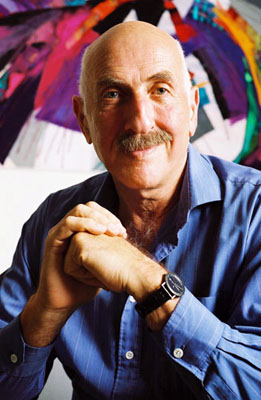
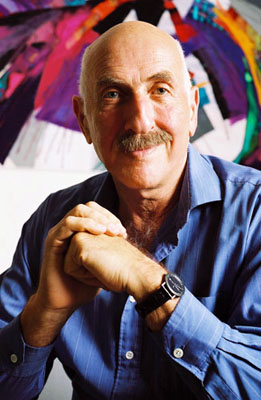
Fritz Klein
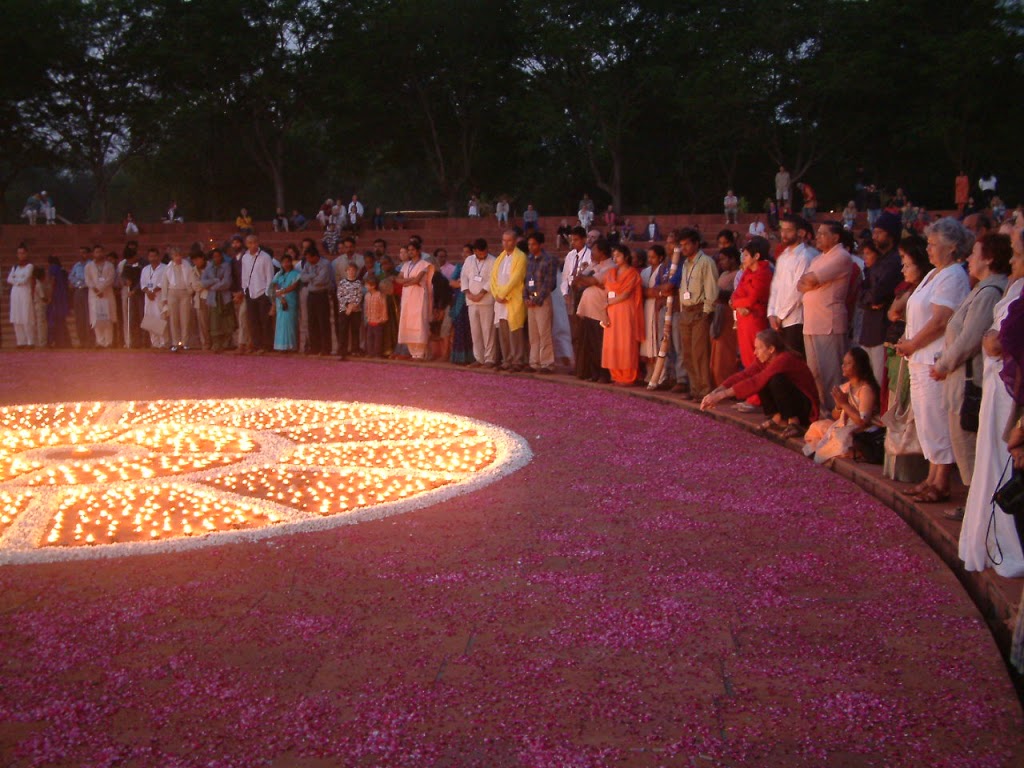
Feb 8, 2004, Dawn at Auroville
Anniversaries are occasions to celebrate.  And the rhetoric I needed to get started on this piece was just not channeling in.  What should I do?  With this context in mind, dear reader, perhaps it won’t be too difficult for you to empathize with my predicament.  What sustainable course of action could I choose that would correspond to authenticity?  Five years have passed from the “In Absentia” semi-trance piece.  Where was Fritz Klein?  What about his legacy?  My mind went to my extended research visit to Auroville, in Tamil Nadu, India, also funded by the UPR system in its golden years.  Auroville is an oasis of international creativity and a “city of dawn” founded in 1968 and named after its spiritual leader, decolonization activist and eclectic avatar Sri Aurobindo.  There, in 2004, I studied patterns of organization, expansion, and sustenance in intentional communities.  I noticed a certain staleness and indecisiveness.  Some would call it lack of vision.  I listened to local informants in the best cultural anthropology, cultural studies tradition.  “What’s the problem?” I asked the ones with most acumen.  “Dead guru syndrome,” they chimed, “we’re stuck between interpreting his word and allowing the vision to evolve as the world does and as he would if here.”  Ouch! 
“Perhaps this applies to my case too,” I reflected, “where is my copy of Fritz’s book?” Maybe that’s where I’ll find inspiration for the right rhetorical mode for this.  I own a copy of the second edition.  And yes, it was all there, the eclecticism, the dialogic ambiguity, the irony and sometime irreverent humor, the admixture of registers from colloquial to erudite, and the searing fearlessness.  The dead often visit me.  And when they do, a magnetic force gets me to open their books and listen to the voice that’s alive still beyond the page and is witness to a life spent in the endeavor to write what has the makings of a classic, something that speaks across time and space to new generations of readers.


[1] The issue of human rights in Puerto Rico has been addressed by the ACLU and Rep Luis Gutierrez, D-Illinois, among others: http://derechoalderecho.org/2011/02/14/human-rights-crisis-in-puerto-rico-aclu/
#  #  #  #  #  #  #  #  #  #  #  #  #

Yours truly appreciates your attention.  Stay tuned for more wonders.

Namaste,

Serena Anderlini-D’Onofrio, PhD

Gilf Gaia Extraordinaire
Author of Gaia and the New Politics of Love and many other books
Professor of Humanities

University of Puerto Rico, Mayaguez

Join Our Mailing List
 GaiaCoverFullSize  
Follow us in the social media
Poly Planet GAIA Blog: http://polyplanet.blogspot.com/ 
Author’s Page/Lists all books: http://www.amazon.com/-/e/B001JS1VKA 
YouTube Uploaded Videos: http://www.youtube.com/SerenaAnderlini
 

Find us on FacebookFollow us on TwitterView our profile on LinkedInView our videos on YouTubeVisit our blog

Join Our Mailing List


http://polyplanet.blogspot.com

2 | Friday is for Poetry | Venerdi Poesia | “A Lake for the Heart | Il lago del cuore” | Luigi Anderlini

Hi lovely Earthlings!
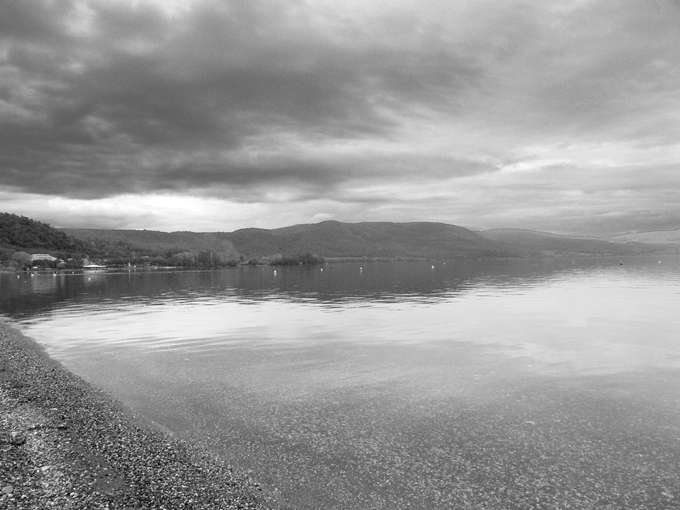
Lago di Bracciano, photo by Ivano Pulcini
Here we come to the second episode of Friday is for Poetry.  The poem, “The Lake,” from the collection, A Lake for the Heart, is by Luigi Anderlini, for yours truly’s translation into English.  For you lovers of Italian–and there are many for this handsome language where so much beauty and knowledge is stored–please scroll down to the end and find the original.  The lake Luigi Anderlini was in love with is il lago di Bracciano, in the vicinity of Rome, the capital of Italy where Luigi’s political career brought him.  The moving aspect of the poem is the way the lake is address like a body of water with a soul, with a will of its own, with a soul.  Echoes of Greek mythology where the forces of nature are treated like Titans whose power we humble humans must acknowledge, came to Luigi through his first wife Lidia’s classical education.  You will get more of that as you come to know her through his poems.  Yours truly now leaves you with the poet’s voice.
 
THE LAKE
“Your roar was but a whisper”
Eugenio Montale “Cuttlefish Bones” – “Mediterranean”
If I look at you from the crenels
of the castle above
the overhanging cliffs,
oh lake, you are in my eyes
a little bit of sky studded
in the gradually lowering valleys.
In the spring, a wide green bed grows around you.
Round like the mouth
0f the volcano you were millions of years ago,
your breath is now
light and secret,
an almost evanescent perfume.
I would like to slide
between earth and sky like your gulls
whose pale shadow is left on water
while the impalpable fluff
of time descends from on high.
On your shores today pile-dwellings like
a hundred centuries ago.  And if I appear
in the mist on the surface of your diaphanous waters
time runs backwards
and I am the animal who invents
the warmth of a home
on boards thrust in mud.
Like a vortex, funnel, or goblet
you descend deep in the abyss.
The north wind sweeps you from above.
It infuriates you, pushing you
to get rid of every impurity.
Or the east wind curls you up, mockingly.
Or the west wind flatters you, careful lover.
Amused, you vary your colors from
indigo to pale green.
The same and different always, across time you exist
and challenge it.  You challenge me too,
as in your presence
I am but an unruly, hopeless maggot.
Ploughed by your ferry’s prow
that heaves a huge whisker of water,
scratched by the keels of your boats,
annoyed by the blades of your rows,
you, lake, hang in there
impassible, and perhaps
in your turquoise summer,
enjoy the lavish colors,
the hundreds sails that bring
a festive glory to all your shores.
At night you smile at the moon’s
long, fringed dazzle, and in the dark
your undertow mumbles
its secret disquiet.
I’ve lived next to you for years.
Between the leaves your blue
arrives at my green shelter.  
I can’t see you but I measure your anger
as I listen to your mumble. 
You lay down large mats of water
on the soft, warm sand.
The curls of your wave
hit the cliff and break.
At night, your falling wave’s
deep thud upsets my heart.
I set off at dusk with my “Piaff.”
Cool form the sea, the west wind
blows into the sail.
The water swashes
around the hull. 
The shore becomes an arched sickle behind me.
A hustle and bustle of voices
follow me through the air.
Then nothing but
the wind’s soft blow into the sail,
my trip in the lake’s deep silence. 
The sunset still dazzles,
its light playing between my jib and spanker.
The hills look on in amazement.
The lake is the back of an enormous liquid animal;
The catamaran you catch a glimpse of
is just a tall shadow in the pouring light.
Silently, it ploughs the water without 
breaking the impending silence.
A voice softly pierces the darkening air
to reach you.
The words you hear are
miraculously new. 
“Ciao!  A cheerful ponentino, ha!  You still at it?  Ciao!”
You feel the hulls’ cut,
as you brush against
the other white spanker.
It’s your last rendez-vous, your last greeting
as the sun goes down behind the withered hills.
Among the thick black plants that mark
the boundary between earth and sky
A glimmer still shines.
Like enormous dinosaurs, with bristly backs
the hills chase one another.
Suddenly a yellow blaze goes off
in the shore’s circle.  A billion years’ jump
back into the past.
The foaming lava seethes
on the crater’s edges.
unconquered nature
Imposes its violent law:
“You’re just a twig in my hands”
she claims, “Then as now,
I am the one to assign destinies,
to keep a firm grip
on each and every life.”
A door closes yet again
in the sky’s vault.
The lance of time wins inexorably
and lets me know that on the shores
I see windows and city lights.
Life travels through time
slowly conquering it, raping it,
printing its marks 
everywhere and claiming them
like flags displayed in the sun.
The wind is down and the lights whiten
in the high silence.
I am alone with you,
lake, lord of the night.
The sail hangs flaccid from the mast, the water
is black with shiny tar,
far away are the stars.
It’s the time of wasted expectations
that one does not give up.
One’s frail hopes rise
the enlightenment of a decision is long to come.
Nor does resignation set in
to console one from pain.
One’s imagination is consumed
yet does not give up–the future still flickers.
The hills’ merry go round has stopped now.
Lake, for you it’s time
to rest, lie down, and steal the quiet
of endless dialogs.
Something different is preparing for me: my last
voyage into the dark.  This ultimate return
ashore feels disquieting. 
Now the wind shakes my sale again:
A light breeze that barely blows from the north.
The boat slides quietly.
Soft and persuasive,
my landing ashore is a
delicate incision on the sand. 
Lake Bracciano, Isotopes
 
Il lago
“il tuo rombo non era che un sussurro”
Montale “Ossi di seppia” – “Mediterraneo”
Se ti guardo dai merli
del castello, che sovrasta
a strapiombo la scogliera,
agli occhi miei tu, lago, sei
un po’ di cielo incastonato
nel lento degradare delle valli.
Ti cresce attorno, a primavera, un ampio letto verde.
Tondo come la bocca
del vulcano che fosti milioni di anni fa,
ora il tuo respiro
è lieve e segreto
quasi lo svaporare d’un profumo.
Tra cielo e terra vorrei
infilarmi come i tuoi gabbiani
che lasciano sull’acqua appena un’ombra
mentre scende impalpabile
– dall’alto – la lanugine del tempo.
Oggi sulle tue rive ancora palafitte come
cento secoli fa. E se nella caligine
affioro al pelo dell’acqua tua diafana
precipita il tempo all’indietro
e sono l’animale che congegna
il tepore di casa
sopra gli assi piantati nella melma.
Profondo – a vortice – come un imbuto
o un calice, tu scendi nell’abisso.
Sopra ti spazza tesa
tramontana che t’infuria e ti spinge
a liberarti d’ogni impurità.
O t’arriccia irridente
il tuo grecale o ti lusinga, accorto
amante, il ponentino.
Divertito tu vari i colori, dall’indaco
al verde pallido.
Sempre uguale e diverso, sei nel tempo
e lo sfidi. Sfidi anche me
che al tuo cospetto sono
ma indocile larva senza scampo.
Solcato dalla prua
del tuo battello
– alza grandi baffi d’acqua –
graffiato dalla chiglia
delle barche, infastidito
dalle pale dei remi,
tu, lago, te ne resti
impassibile e magari
d’estate ti godi nel tuo turchese,
lo scialo dei colori,
le cento e cento vele
glorianti a festa tutte le tue sponde.
La notte ridi al barbaglio
lungo e sfrangiato della luna
e la tua risacca borbotta
nel buio segreta inquietudine.
Da anni ormai ti vivo accanto.
Al mio rifugio verde arriva
– tra le foglie – il tuo azzurro.
Non ti vedo ma ascolto
il tuo mormorare, misuro
la tua collera: i grandi
tappeti d’acqua che stendi
nella rena morbida e calda,
l’onda arricciata che precipita
e si frange sulla scogliera
o il tonfo profondo
del flutto che s’abbatte
e che di notte mi annega
il cuore in subbuglio.
Parto al tramonto così il mio “Piaff”.
Nella vela il ponentino
soffia fresco dal mare.
Sciaborda l’acqua a circuire
limpida lo scafo. S’innarca
dietro di me, larga, la falce
della spiaggia: tramestio
di voci che m’inseguono
nell’aria. Poi non resta
che il soffice soffio del vento nella vela,
il viaggio nel silenzio denso e assorto del lago.
Barbaglia ancora il sole che tramonta,
tra randa e fiocco gioca alterna la luce.
Guardano stupefatte le colline.
Il lago è il dorso d’un enorme animale liquido
ed il catamarrano che intravedi
è ancora un’ombra alta nella luce che spiove.
Solca silente l’acqua e non incrina
il silenzio che incombe.
La voce che ti arriva
perfora tenera l’aria che imbruna.
Miracolosamente
nuove sono le parole che ascolti.
“Ciao! Allegro il ponentino! Tu vai ancora? Ciao!”
Avverti il taglio degli scafi,
dolcissimo è il fruscio
dell’alta randa bianca.
È l’ultimo incontro, l’ultimo saluto
cala il sole dietro le colline stecchite.
C’è ancora chiarore
tra le piante fitte che – nere – segnano
il confine tra cielo terra e cielo.
Enormi dinosauri le colline
che – irsuto il dorso – immote si rincorrono.
All’improvviso scatta
nel cerchio delle rive una vampata
gialla. Si torna indietro
di miliardi di anni:
alla lava che schiumando ribolle
ai bordi del cratere,
alla natura indomita
che impone violenta la sua legge:
– “Altro non siete che un fuscello” – dice–
“Nelle mie mani. Allora come oggi.
Sono io che segno i destini,
che ferma mantengo la mia presa
sulla vita di tutti e di ciascuno”.
Ma un’altra porta si chiude
di nuovo nella calotta del cielo.
Inesorabile vince la lancia del tempo
e mi dice che quelle sono luci
lampioni, finestre accese sulle rive.
È vita che viaggia nel tempo
e lenta lo conquista e lo violenta
che stampa le sue impronte
ovunque e le reclama
come grandi bandiere esposte al sole.
Caduto è il vento, altissimo è il silenzio,
si sbiancano le luci.
Sono solo con te
– lago – che sei padrone della notte.
Dall’albero pende flaccida la vela, l’acqua
è nera di catrame lucido,
lontane le stelle.
È questa l’ora delle attese vane,
in cui non ci si rassegna.
Crescono gracili le speranze
e tarda il lume delle decisioni
e la rassegnazione non arriva
a consolarti della pena.
La fantasia si consuma
ma non cede, balugina ancora il futuro.
S’è fermata attorno la giostra
delle colline. Per te – lago – è l’ora
del riposo disteso, della quiete
rubata, dei colloqui senza fine.
Altro per me si prepara: un ultimo
viaggio nel buio, un ritorno inquieto
verso l’approdo estremo.
Ed eccolo il vento che scuote la vela:
soffice, da nord, appena una brezza leggera.
Scivola tacita la barca.
L’approdo è una incisione
morbida e persuasiva,
dolcissima sulla rena.
1996
Did you enjoy the poem?  Let us know!  Yours truly appreciates your attention.  The comments box is open.

The poems will appear every Friday at 11:00 AM.  Come back!  And get your copy of A Lake for the Heart right away!

Stay tuned for more wonders.

Namaste,

Serena Anderlini-D’Onofrio, PhD

Gilf Gaia Extraordinaire
Author of Gaia and the New Politics of Love and many other books
Professor of Humanities

University of Puerto Rico, Mayaguez

Join Our Mailing List
 GaiaCoverFullSize  
Follow us in the social media
Poly Planet GAIA Blog: http://polyplanet.blogspot.com/ 
Author’s Page/Lists all books: http://www.amazon.com/-/e/B001JS1VKA 
YouTube Uploaded Videos: http://www.youtube.com/SerenaAnderlini
 

Find us on FacebookFollow us on TwitterView our profile on LinkedInView our videos on YouTubeVisit our blog

Join Our Mailing List

A Lake for the Heart

http://polyplanet.blogspot.com

2 of 7 – Bisexual Epistemologies: A Journey from Nausea to Commitment

Bisexual Epistemologies: A Journey from Nausea to Commitment 
An occasional piece by
Serena Anderlini-D’Onofrio, PhD
For The Journal of Bisexuality’s 10th Anniversary Issue
Hi dear readers!
This seven-in-one piece will be great fun–yours truly promises.  Find out all the ins and outs of 10 years of Bisexuality!  What does “epistemology”mean?  Big word, right?  Well, all it means is that when you’re making love you’re producing knowledge.  A good thing!
We follow the abstract with the Introduction, and will have five more posts.  Really revealing of all those things about bi you’ve always been curious about.  Why is it so good?  What can it do for you?  For the planet?  For the future?  For authentic intimacy?  It’s all here, spiced with a bit of irony and critique of why we’re so behind on our agenda.  What’s keeping us from being more efficient.
Also arcane words you’ve been told have no meaning unless you got a PhD are explained–made very easy!  “Nausea,” “existentialism”: it’s all about the chakra system–really.  Commitment?  It’s not about going to jail (as in, “being committed”).  But rather, it’s about “being-in-action” about things.  Being the one who makes the difference!  No mysteries.  Woooooow!  Come back for more, will you?  We’ll post every week, on Tuesdays.
Namaste,
Serena


2. Introduction
It is an acknowledgement to be invited to contribute to this anniversary issue.[1]  Ten Years of Bisexuality is how fellow-traveler eclectic and queer-theory pioneer David Halperin would probably call this–not to mention Nobel Laureate in Literature Gabriel Garcia Marquez, who might have preferred Ten Years of Solitude.[2]  Let this occasional piece be an opportunity to analyze the miracle of planetary consciousness and political circumstances that has been at cause of my being part of it, and reflect on what we might learn from the results.
 In 2003 I was invited to guest edit the issue that became Women and Bisexuality: A Global Perspective.  Regina Reinhardt, the journal’s associate editor, was a close collaborator of Fritz Klein, founder of the journal.  She offered the opportunity and the issue ended up collecting articles from four different continents.  In 2005 I invited myself to guest-edit an issue on the intersections of polyamory and bisexuality.  Fritz Klein initially resisted the idea.  As a seasoned good listener who would allow eloquence and a good argument to convince him, he eventually agreed.  It became Plural Loves: Designs for Bi and Poly Living, now an appreciated book in poly communities for research and practice.  Fritz Klein passed in 2006, and I remember writing, in a post-traumatic state of semi-trance from the death of a respected friend and intimate leader, “In Absentia,” a short introductory piece for the issue about to go to print.  When Jonathan Alexander came in as editor-in-chief anointed by the Fritz Klein legacy that funds this initiative, I proposed Bisexuality and Queer Theory (2010).[3]  This issue is now in production as a book that promises to bridge the discursive gap between practice and theory, communities and ivy leagues, or the body and the mind, to use shorthand from new age speak.  There were no conferences in North America in years subsequent to Klein’s passing that would offer spaces for continuance of the integration of discourses auspicated by the activist scholarship to which I devote my energies.  When the energies for one such conference jelled in England, in 2010, I was invited to keynote and sparkled the idea of the proceedings volume that became BiTopia, now in print as a journal issue.[4]
Every issue has been a labor of love devoted to the overarching commitment to the scientific invention of a world where love for love, or erotophilia, is revered.  As an activist scholar, I don’t follow trends that promise prestige.  I chart new fields that offer the opportunity to make the world a better place for those who love love as I do and are willing to stand for an inclusive amorous vision beyond binaries and divisive dualisms.  This requires a public profile that involves risk.  It also involves the effort of being beyond the lateral hostilities that often make coordination among activists, communities, advocates, and academics difficult, as well as a vision whose horizon is wider than the sum of often conflicting academic sectors and disciplines.  I hope to have kept faith to my overarching intent at all times, even though I am aware that in some cases this is just wishful thinking.
Over this period I have considered myself a participant observer and research activist of bisexuality, as an in-flux identity, a diverse community, a subculture interspersed with tropes from other, contiguous groups, and a practice of love rich with many variations.  Bisexuality is just as healthy as any other sexual orientation, Fritz Klein established with his seminal work in the mid 1980s, The Bisexual Option.  If fact, when social and cultural causes for neuroses that can accrue from it are removed, it is even healthier since it corresponds to the potential for “100 Percent Intimacy,” as indicated in the subtitle he chose for that book.[5]  Klein focused on how this applies to the individual, as in the kind of therapeutic approach that can help a bisexual person feel comfortable with her/his orientation and related practices of love. 
Today cultural discourse about the interconnection between sexuality and consciousness has developed much further.  Many of us believe that active sexual education and amorous expression, not the stillness of a couch with the “talking cure,” is where the healing begins.  We are also more aware of planetary consciousness, or the noosphere–which has been further activated by cyberspace interactivity.  In this evolving cultural context, Klein’s claim about the health of a bisexual person can be projected on the wider horizon of global ecological health, which can thrive on the expansion of human sexual fluidity and amorous inclusiveness.  In a homeopathic rhetorical turn, one might theorize bisexuality, and/or the fear thereof, as the “problem” which is the solution, the “disease” which is the cure, the “lie” which is the truth, in an algorithm with the potential to heal personal, relational, cultural, social, ecological, emotional, and economic wounds all the way back to Plato’s dualisms. 
When we look forwards we can envision bisexuality as an engine in the paradigmatic shift toward a future of sexual fluidity and amorous inclusiveness where the energies of love and life are revered.  In other words, bisexuality is the foundation of a new epistemology based on love for our hostess, third planet Gaia, and the mantle teeming with life that she has enshrined herself in to welcome the life journeys of an amazing range of interdependent beings, from humans to bacteria and everything in between.[6] 
If bisexuality is an epistemology–or at least a significant element in the new episteme toward which planetary consciousness is shifting–then we may want to go back to literature, the art of wordsmiths, to sort out what this means.


[1] Jonathan Alexander, the editor-in-chief whose rhetorical expertise has been so instrumental in keeping the Journal going since Fritz Klein’s death, is the one who helped me see the call to contribute to this issue as a form of recognition for my role in affirming the Klein legacy.  I owe him many of the insights of this piece.  Our conversations were very inspiring.  Another debt is owed Regina Reinhardt for also insisting.  Thank you!
[2] My references are David Halperin, One Hundred Years of Homosexuality, and its palimpsest, Gabriel Garcia Marquez, One Hundred Years of Solitude, by now two respected classics in their own discursive ambits.
[5] The Bisexual Option was published in the early 1980s with the subtitle A Concept of One Hundred Percent Intimacy.  It went into its second edition in 1993. 
[6] The reference here is my own work on bisexuality and global ecological theory, in Gaia and the New Politics of Love (2009).

Yours truly appreciates your attention.  Stay tuned for more wonders.

Namaste,

Serena Anderlini-D’Onofrio, PhD

Gilf Gaia Extraordinaire
Author of Gaia and the New Politics of Love and many other books
Professor of Humanities

University of Puerto Rico, Mayaguez

Join Our Mailing List
 GaiaCoverFullSize  
Follow us in the social media
Poly Planet GAIA Blog: http://polyplanet.blogspot.com/ 
Author’s Page/Lists all books: http://www.amazon.com/-/e/B001JS1VKA 
YouTube Uploaded Videos: http://www.youtube.com/SerenaAnderlini
 

Find us on FacebookFollow us on TwitterView our profile on LinkedInView our videos on YouTubeVisit our blog

Join Our Mailing List
http://polyplanet.blogspot.com

1 | Friday is for Poetry | Venerdi Poesia | “A Lake for the Heart | Il lago del cuore” | Luigi Anderlini

 Hi lovely Eathlings!
Luigi Anderlini
for the summer yours truly has decided to share something really beautiful and personal.  Her dad, Luigi Anderlini, was a really extraordinary person.  A poet, memoirist, and intellectual who came from teaching and dedicated himself to politics, he was such a model of honesty that when the entire political class of his generation came under attack for corruption by the judicial system–in the early 1990s–yours truly never even doubted for a moment that he was at any risk of being found wrong.  And he wasn’t!  
Today, with rampant greed pervading civil life, mainstream media, and politics, with a whole new class of nouveaux riches–the new rich whose money was made in the digital revolution and is now embezzled out of the economy and into some tax havens, or paradisi fiscali as they say in Italian–this is so rare as to demand celebration!
Because her dad was a poet, and because he so loved nature that one might say he almost feel in love with it like an ecosexual would do, yours truly happily celebrates this occasion with the forthcoming series Friday is for Poetry, or Venerdi poesia, as Italians would say.  The poems in this series are part of the collection her dad left for publication after his death, A Lake for the Heart, or Il lago del cuore.  Yours truly had the privilege of doing the translation and introduction to the bilingual edition for Gradiva Press in 2005.  This really helped her grieve the loss.  The death of Luigi Anderlini was a bit like the death of an age in the world where he emerged as a public figure, Italy, and later Europe and the world.  Her relatives kept asking, “aren’t you missing your dad?”  She replied, “no, because I’m with him every day when I translate one of his poems.”  Translators, especially good translators, really crawl under one’s skin.  They penetrate our body and soul.  Yours truly never felt as close to her dad as when she translated his poems.  Many of them made her cry over and over.  And revealed to her aspects of life beyond death.  It was an intimacy forbidden in the secular world.  And so she kept telling herself that this translation process felt a bit like post-mortem incest. Oh well . . .
Here she will reproduce the poems that stirred her emotions most, “The Lake,” “Women,” and “Lydia.”  You lovely earthlings who will read the series will become familiar with the poet, the fine, sensitive person whose emotions became chiseled in words.  The plan is to follow this with a short biography–the introduction to the collection–that will reveal more of the public figure and political person–the agent of change that Luigi Anderlini was in his era.  
Barak Obama and Hillary Clinton
Oh, if more poets came onto the scene of politics!  Obama, for one, is a good rhetorician, and–unlike his predecessor–he can spell.  He is literate, a cultured person.  And he can choose words.  Words, in politics and everything else, are not “just words.”  They are what stirs the imagination to make a transformed reality possible.  Politics is a chiseling of words.  Or not!  Obama has distinguished himself as a chiseler, and yours truly’s dad, who was known in Italy for crossing the color lines, would have been so happy to know that a man of two races followed the dark years of the shrub era.  When politics is not a chiseling of words, it can be a string of insults, a non-rhetoric of slander and offensiveness that only reflects the ignorance of those deluded enough to think that it it will benefit them, as in, say, the Tea Party Movement and its followers.
Poetry, however, is more than rhetoric, even elegant rhetoric.  Poetry is a search for the soul.  And that’s what the collection yours truly translated was.  A man consciously approaching the last door, with the memory of a life lived in integrity, an authentic life, an imperfect life, a life that made sense.  A man who chooses to dedicate time before death to chiseling the literary legacy of this life.  A legacy where the most personal aspects and the most public ones are integrated, in a somewhat feminist fashion dare one say.
As you stay with the project, dear reader and lovely earthling, you will come across the premonitions of ecosexual love in some of Luigi Anderlini’s poems, and the legacy of questions from her father’s biography that came up for her, as yours truly explored the possibility of finding answers for them in the inclusive practices of love of which she is now aware.
The poems will appear every Friday at 11:00 AM.
Come back! And get your copy of A Lake for the Heart right away!

Yours truly appreciates your attention.  Stay tuned for more wonders.

Namaste,

Serena Anderlini-D’Onofrio, PhD

Gilf Gaia Extraordinaire
Author of Gaia and the New Politics of Love and many other books
Professor of Humanities

University of Puerto Rico, Mayaguez

Join Our Mailing List
 GaiaCoverFullSize  
Follow us in the social media
Poly Planet GAIA Blog: http://polyplanet.blogspot.com/ 
Author’s Page/Lists all books: http://www.amazon.com/-/e/B001JS1VKA 
YouTube Uploaded Videos: http://www.youtube.com/SerenaAnderlini
 

Find us on FacebookFollow us on TwitterView our profile on LinkedInView our videos on YouTubeVisit our blog

Join Our Mailing List

A Lake for the Heart

http://polyplanet.blogspot.com

1 of 7 – Bisexual Epistemologies: A Journey from Nausea to Commitment

Bisexual Epistemologies: A Journey from Nausea to Commitment 
An occasional piece by
Serena Anderlini-D’Onofrio, PhD
For The Journal of Bisexuality’s 10th Anniversary Issue
Hi dear readers!
This piece will be great fun–yours truly promises.  Find out all the ins and outs of 10 years of Bisexuality!  What does “epistemology”mean?  Big word, right?  Well, all it means is that when you’re making love you’re producing knowledge.  A good thing!
We begin w/ the abstract, and will have six more posts.  Really revealing of all those things about bi you’ve always been curious about.  Why is it so good?  What can it do for you?  For the planet?  For the future?  For authentic intimacy?  It’s all here, spiced with a bit of irony and critique of why we’re so behind on our agenda.  What’s keeping us from being more efficient.
Also arcane words you’ve been told have no meaning unless you got a PhD are explained–made very easy!  “Nausea,” “existentialism”: it’s all about the chakra system–really.  Commitment?  It’s not about going to jail (as in, “being committed”.)  But rather, it’s about “being-in-action” about things.  Being the one who makes the difference!  No mysteries.  Woooooow!  Come back for more, will you?  We’ll post every week, on Tuesdays.
Namaste,
Serena


Abstract
Fritz Klein
This occasional piece captures the experience of being a guest editor for four issues of Journal of Bisexuality, from 2003 to the present time.  It is also a reflection on that experience. What is there to learn from it?  Is it possible to create a culture of research on bisexuality that empowers people to live authentic lives–and fulfill Fritz Klein’s promise of a healthy bisexuality whose gift to the world is the joy of 100 percent intimacy?  The article is made of an introduction to the four issues, on women and bisexuality in a global perspective, on polyamory and bisexuality, on bisexuality and queer theory, and on community-related research about bisexuality that gives off the effect of a bi utopia, or bitopia.  It discusses the Fritz Klein intellectual legacy and what it means in terms of understanding the role of bisexuality in today’s world and its potential to contribute to a paradigm shift towards an epistemology based on love for love, or erotophilia.  It discusses in depth the circumstances under which the “miracle” of “ten years of bisexuality” has been possible in a decade of planetary disarray and human distress.  And it gives special attention to the circumstances in which the four issues came into being.  The article further samples significant contributions to the issues, including those by Maria Pallotta-Chiarolli, Betty Dodson, and Deborah Anapol, all of whom pioneers and leaders in the sex-positive movement.  Finally, the article also positions the author as a scholar activist whose method of criticism can be termed “holistic” because it integrates correlated approaches synergistically, including close reading and cultural theory. 

Keywords: healthy bisexuality, erotophilia (love for love), erotophobia (fear of love), holistic cultural theory, epistemology (how we get to know things, what we think knowledge is), utopia (ideal world), women, polyamory, Fritz Klein, love, existentialism (what makes existence meaningful), Sigmund Freud

Yours truly appreciates your attention.  Stay tuned for more wonders.

Namaste,

Serena Anderlini-D’Onofrio, PhD

Gilf Gaia Extraordinaire
Author of Gaia and the New Politics of Love and many other books
Professor of Humanities

University of Puerto Rico, Mayaguez

Join Our Mailing List
 GaiaCoverFullSize  
Follow us in the social media
Poly Planet GAIA Blog: http://polyplanet.blogspot.com/ 
Author’s Page/Lists all books: http://www.amazon.com/-/e/B001JS1VKA 
YouTube Uploaded Videos: http://www.youtube.com/SerenaAnderlini
 

Find us on FacebookFollow us on TwitterView our profile on LinkedInView our videos on YouTubeVisit our blog

Join Our Mailing List

http://polyplanet.blogspot.com

3WayKisses from Gaia – Summer & Fall Calendar in the Arts of Loving

Hi lovely Earthlings!
Gaia sends 3WayKisses and warm wishes to all of you!  Happy spring, summer, and fall seasons!
In the midst of planetary transformation, we have been navigating the shift on multiple helms.  The ecosexual movement is picking up steam, and we are honored to be part of it.  Let’s treat Gaia like a lover, hostess, mother, we respect and revere!
Teaching students about the arts of loving as practiced in the early modern and modern period has been a joy rewarded with the good fortune to complete the academic year.  Veronica Franco and Giacomo Casanova are always big hits.  This year we also got in Ntozake Shange and bell hooks!  Remembering BiReCon and orchestrating BiTopia, the volume that collects its proceedings, has been another reward for yours truly.  Bi is “kewl”!  Bi Social Network interviews.  Listen here, click April 20.  We wish many more bi conferences in the future and were asked to celebrate 10 years of bisexuality with an occasional piece.  What recognition!
Gaia’s Shore, Cabo Rojo, Puerto Rico
Defending human rights and and shoring the assault on the public sector in Puerto Rico has been a priority as our university bleeds some of its best and most qualified people. Aprum and its allies have been helpful in supporting this.  With our livelihoods under assault, we’ve been keenly aware of how ugly greed looks when it’s desperate with fear.  Meanwhile Gaia tends its shores with the sweet waves of the Caribbean.  The oceans have not inundated beach communities, and the dry season has been unusually cool.  Gaia’s patience is admirable in the context of human ingratitude.  Fukushima’s radiation sears complex organisms with the Petkau effect that stores toxicity in our tissues.  Perhaps Gaia is waiting for ecosexuals to soar and teach the arts of loving that can shift planetary consciousness to manifest an energy field that can heal nature from human abuse.
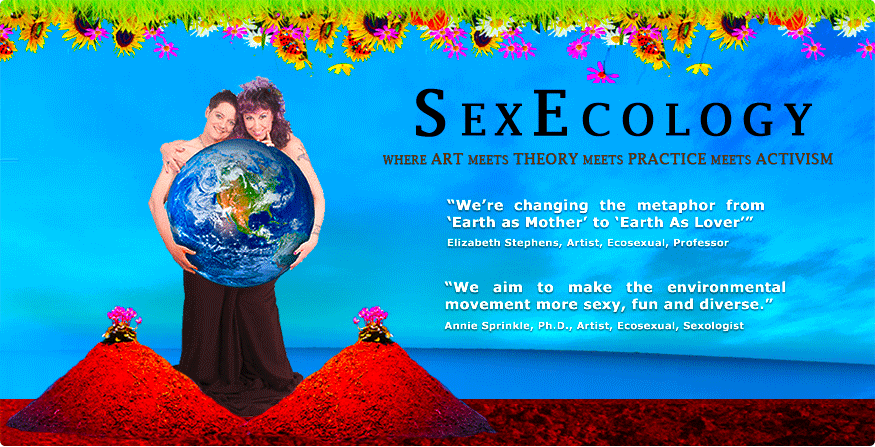
Annie and Beth

The summer and fall calendars have now firmed up with a series of events devoted to the arts of loving consciously and inclusively as an ecosexual path to world peace, joy, health, and well being.  Are we going to succeed?  Time will tell, and in the meanwhile, let’s bet on our own duly acquired, time-tested wisdom.  Read what Modern Love Muse thinks!

Gilf Gaia Extraordinaire
The first event is approaching soon.  Ecosexual Unite for an Ecosex Symposium & Art Exhibit, says the press release Coming up on June 17-19!  Ecosex artists extraordinaire Annie Sprinkle and Beth Stephens produce at the new Center for Sex and Culture in San Francisco.  What an honor to be invited to speak! Ecosex Symposium II & Art Exhibit is where art meets theory meets practice meets activism.  What synergy could be more complete?  Yours truly with her new persona, Gaia Gilf will be reading from the preamble of her new book, What’s Ecosexual Love? (G is for grandma–or nonna, as they say in Italy–because Gaia, the third planet, is old enough to be a wise and seasoned teacher in the arts of love too.)  Interpreting love as an art is key to a culture’s ability to generate inventiveness, joy, creativity, and wisdom.  Ecosexual love is what cures nature from human abuse.  The ecosexual movement is the tidal force of that cure.  Time to join in! Don’t miss a beat: The symposium is up and seats are limited.  Get yours for only $ 35!  For ecoliscious lunch add $ 15. Find out more and sign up immediately when you click this link!
Fakistra beach, Greece

Next in line is yours truly’s trip to Kalikalos, Greece, the holistic community that hosted her seminars on “Gaia and Amorous Resources: What’s Holistic about Poly?” last year, with Bonobo Coaching sessions to follow up on the epiphanies that ensued.  I sure don’t know what it is, but when a culture is replete with such ancient wisdom, the dualisms of modernity don’t seem to make a big difference.  Things are all so integrated, so symbiotic it’s not even worth mentioning that we’re all part of the same living ecosystem.  If sharing resources is what creates abundance, why not go the poly way and figure out how to share resources of love too?  Kalikalos is an inclusive international community held together by host extraordinaire Jock Millenson, an admirer of Zegg and scholar of intentional communities.  Kalikalos hosts great facilitators, including Brad Branton of Radical Honesty Rag.  Check it out here.  This summer the trip includes yours truly’s beautiful daughter Paola and her two wonderful children, Alessio and Leonardo.  We will be there June 25th to July 8th.  Sign up for a holistic vacation during that period and you’ll find out how to make your love life more holistic, with the added bonus of Bonobo Coaching open to you.

Ecosexuality
Five days of Ecosexuality in Italy with yours truly and Robert Silber comes up right next, July 16-21.  This is the first multilingual course on this theme, with an experiential and theoretical curriculum.  When Conscious Sensuality meets 3WayKiss things can become quite interesting.  The ecosexual arts of conscious loving become real.  Translator extraordinaire Veronika Reizner, also a holistic healer, joins the team from Austria too.  Participants come from as far as Turkey and New Zealand and everywhere in between.  We will be in the heart of the Alps, mountains of pristine beauty.  Enjoying the taste of Italian cuisine.  What could be a better setting for an ecosexual consciousness about to break lose?  A few slots are left for those with a strong interest.  Check it out here and grab one immediately!  The cost goes up to full price on May 31st.
Zegg
Zegg is next with its Summercamp week, July 22-29.  In the heart of Germany’s eastern region, this intentional community models open relationships and shared living in ways that are exemplar and unique.  Summercamp is their holistic-organization week.  The core groups opens up to visitors.  “Eros and Community” is this year’s theme. Yours truly signs up to peak in.  Her chance to learn how to organize expanded families based on sexual fluidity and amorous inclusiveness.
Toronto, Canada
Last and by all means not least is a trip to Toronto, for the fall Canadian edition of the ISTA Conference, the International School of Temple Arts.  The arts of loving are sacred to Gaia: they are the source of all life, creativity, consciousness, healing.  Accordingly, the Toronto team has secured the Bathurst Center, an educational space in culture, arts, and media.  The team is gang-ho about ecosexual love too.  Yours truly will be leading workshops and keynoting on her favorite theme.  What an honor to be invited to speak!  Toronto is vibrant with intellectual energy applied to the arts of loving and healing.  Yours truly has mobilized all her friends, acquaintances, and co-leaders to participate in this.  It will be a path-breaking experience, an epiphany for healers and artists of love to synergize the planetary consciousness that allows ecosexual love to heal nature from human abuse.  Join us and be part of the paradigm shift to the world we need.  Love of love is sacred and the art of teaching it is revered.  More on this as things evolve.  Stay tuned.  Follow our blog for updates, join our list, and “like” the Gaia page” on Facebook.  It all pays off when you get to hear what intriguing things we’ve been up to!
On this note, we wish a joyful summer to the entire planet and all of you.  The masses are in an uproar in the Mid West and the Middle East.  Meanwhile, the new rich of the digital era hide their billions in secret vaults based in Treasure Islands where tax is moot.  What kind of politics is this?  We at 3WayKiss have solutions.  The new politics of love we propose is ecological and sexy too.  Vive ecosexuality!  Stop third planet abuse!  As a summertime resolution, can we pledge to practice love and respect for our lovely hostess?  Let’s hope Gaia finds more patience within.  Meanwhile, thanks to Annie and Beth for their lovely pictures.  Get more here!
Namaste,Serena Anderlini-D’Onofrio, PhD
Gilf Gaia Extraordinaire
Author of Gaia and the New Politics of Love and many other books
Professor of Humanities

University of Puerto Rico, Mayaguez

 
Follow us in the social media
Author’s Page/Lists all books: http://www.amazon.com/-/e/B001JS1VKA

Find us on FacebookFollow us on TwitterView our profile on LinkedInView our videos on YouTubeVisit our blog

Join Our Mailing List
http://polyplanet.blogspot.com

PRESS RELEASE – SF 6/17-19: ECOSEXUALS UNITE FOR AN ECOSEX SYMPOSIUM & ART EXHIBIT

PRESS RELEASE
MAY 22, 2011
Contact: Center for Sex and Culture (415) 902-2071
Femina Potens Press: Malia Schaefer feminapotenspress@gmail.com
Serena Anderlini: serena.anderlini@gmail.com
 iphone: (787) 538 1680
Elizabeth Stephens: bethstephens@me.com
San Francisco, Ca.

ECOSEXUALS UNITE FOR AN ECOSEX SYMPOSIUM & ART EXHIBIT

What’s an ecosexual? Why are skinny-dipping, tree-hugging and mysophila so pleasurable? Where is the e-spot? Can the budding ecosexual movement help save the world? Who are the ecosexuals? These are some of the questions that will be discussed at the Ecosex Symposium II- a public forum where art meets theory meets practice meets activistism.
The organizers of these events are Annie Sprinkle, Ph.D., a feminist-porn-star and artist, turned “sexecologist,” and Elizabeth Stephens, a UCSC art professor and environmental activist. The two women explain, “As a strategy to create a more mutual and sustainable relationship with our abused and exploited planet, we are changing the metaphor from the Earth as mother, to Earth as lover.”
Artists and sybaritic cougars, Sprinkle and Stephens kick off the weekend with their “Ecosex Manifesto” an art exhibit with new collages, their ecosex wedding videos and ephemera, ecosexual photographs, and a wall text with their manifesto. Stephens and Sprinkle create art that aims to inspire more love and appreciation for the Earth and environment. The art exhibit and symposium are sponsored by Femina Potens Gallery and all events will happen at the new Center For Sex & Culture at 1349 Mission Street. The artists got a cultural equity grant from the San Francisco Arts Commission to help make it all possible.

Ecosexual theorist and author of seminal text, Gaia and the New Politics of Love, Serena Anderlini, Ph.D. is travelling from University of Puerto Rico to present the keynote, What is Ecosexual Love? A Guide to the Arts and Joys of Amorous Inclusiveness. In this production by 3WayKiss, she’ll impersonate a GILF. Good Vibration’s resident sexologist, Carol Queen, Ph.D., will be discussing ecorotic issues in the sex toy industry and The Sexology of Ecosexuality. Dr. Robert Lawrence, Ph.D. will cover ecosex fetishes. Also presenting are Madison Young, an award winning queer porn movie director and artist who will cover the Greening of the Sex Industry. Artist Tania Hammidi will do a dance piece about conflict, genocide and olive trees. There will be a special ecosexi-love-a-licious vegan raw lunch by Becka Shertzer’s Brazennectar and Mister Cream. Other presenters are artist musicians Dylan Bolles & Sasha Hom, yogi and academic Amy Champ, and the legendary porn actress Dr. Sharon Mitchell who will talk about the sensuality of gardening. Author of the book Ecosex, Stephanie Iris Weiss will be skyping in from New York for a panel. Erospirit Institute director, Joseph Kramer, Ph.D. will expound on the spiritual aspects of ecosexuality. Other speakers will present on many more aspects of this budding new sexual movement. There will also be an open forum for symposium participants to share their work and thoughts.

Although Stephens and Sprinkle use humor in their work, they are very serious about engaging ecosex as an environmental activist strategy. They aim to, “make the environmental movement a little more sexy, fun and diverse.” Additionally, they’d like to see an “E” added to GLBTQI.
PRESS PHOTOS: Available at http://loveartlab.org/press-gallery.phpINFORMATION AND TICKETS: http://www.sexecology.org/
Friday, June 17
7:00-9:30 ECOSEX MANIFESTO ART EXHIBIT OPENING &
ECOSEX SYMPOSIUM RECEPTION (Free)
Saturday, June 18
Sunday, June 19 10:00-1:30
ECOSEX SYMPOSIUM 11 ($35. No one turned away for lack of funds.)
10:30 AM to 10:45 PM

ECOSEX MANIFESTO ART EXHIBIT

The Ecosex Manifesto Art Exhibit by Elizabeth Stephens & Annie Sprinkle will be open for public viewing through July 24th.
Gallery Days and Hours: Thursdays and Fridays: 6/23 + 6/24 2:00-5:00 PM, 6/30+ 7/1 2:00-5:00 PM, 7/21 + 7/22 2:00-5:00 PM Or by appointment with the Center for Sex & Culture.

RELATED EVENTS

June 16, 8:00 Femina Poten’s ECOSEXUAL QUEER PORN NIGHT-At ATA
June 19 5:00-7:00 DIRTSTAR PERFORMANCES at the Tenderloin National Forest/Luggage Store
What is 3WayKiss?  We’re a non-profit dedicated to educating the public about the arts of loving and their infinite forms of expression, especially those that are playful, joyful, healthy, open, sustainable, and inclusive.  We intend to foster a public climate where the arts of loving are seen as a form of the arts of healing, and the global effort to create an emotionally sustainable planet where trusting others and sharing resources is seen as the source of abundance and peace in the world.
http://polyplanet.blogspot.com

Assuaging AIDS Fears: The Eco-Sexual Arts of Sharing Love

As an author and cultural analyst, I have touched on the topic of AIDS on several occasions, before Montagnier’s interview and when the issue was really embattled.  I have also been publically attacked.  And certain venues have banned me.  Cultural interpretation is extremely important in all areas of knowledge, including medicine.  Now that more is becoming apparent about the multiple perspectives from which AIDS can be interpreted and why, it is time to pronounce myself in a clear and succinct position statement that will help others orient themselves in relation to what I know and where I stand.
In my observation, when science production is commodified for profit by the private interests of Big Pharma, what often happens is that most virologists become “of the virus party.”  This literary expression implies that they may (inadvertently perhaps) start rooting for the viruses they are researching.  In this case, their commitment to put humans first and protect us from harm might slip to the back of their minds.  After all, if they can prove that the virus they study causes real harm, they may get the Nobel Prize.  This mindset is a betrayal of the Hippocratic oath that all medical scientists are sworn to, namely “first do no harm.”  Why?  Because believing that one is ill can cause one to die.  Medicine CAN “do harm” and that’s why the Hippocratic oath is still practiced.  In Greek, the word “pharmakon” means poison.  Next time you refill your meds, think about it.
(This theory is explained in “Of the Virus Party,” a wide-ranging section of my book Gaia and the New Politics of Love.)
Jumping to conclusions about a putative pathogen can be good to a virologist’s career. However, it is potentially harmful to humankind because human health is multifactorial and related to the emotional and physical ecology that surrounds human life.
HIV testing is the first step on this path.  The reliability of the test has been seriously questioned on all counts.  Furthermore, anonymous testing has been banned in countries where health care is for profit and private.  It is allowed and encouraged in countries with universal heath-care systems that function well and are free of charge, including France, Italy, and many others.  It would appear that as long as science cannot cure a disease, for the protection of individuals against medical error and other abuses of power, anonymous testing should be allowed.  For those without access to anonymous testing in their home countries, self-test kits can be ordered from Switzerland for about $ 40.  They are very easy to use at home and quite reliable.  Confidential testing is only anonymous as long as there is no error or positive result.
Testing anonymously can help one feel better and safer.  It can help assuage fears for oneself, one’s partners, and partners of partners.  As a person who’s been med-free for over 25 years now, I have come to rely on meditation, nutrition, healthy emotional and physical environment, good connectedness with self, a fulfilling and diverse amorous life, and inner balance, rather than testing and chemical drugs.  Attributing excessive significance to testing is not wise since by and large one’s health is proportional to the strength of one’s immune system rather than absence of exposure to pathogens.  Erotic, amorous, sensual, and affectional expression are big factors in the health picture of everyone.
What I bring to this conversation is also my experience as participant observer in erotic communities where resources of love are shared–and therefore abundant–as in those that practice some form of polyamory and/or bisexuality.  People in these communities typically have sex with a limited number of partners, sometimes simultaneously and over an extended period of time.  Typically this happens with full disclosure for all involved, including disclosure of number of partners and their health status.
My wisdom is that in these contexts, some measure of safer sex is highly desirable.  We live in a time when the foundations upon which human knowledge is based are shifting.  Not surprisingly, people’s different understandings of STDs are not aligned enough for everyone to feel safe and comfortable otherwise.  Plus, not all diseases known to the public have a standard cure.
There is a wide range of safer-sex practices, referring, in general, to superficial body fluids, like saliva, and deep body fluids, like sperm, female ejaculate, and blood.  Safer sex practices can vary.  Complete safety typically implies dry kissing, barriers in oral sex, and condoms in penetration.  Deep-fluid only safety is also practiced, involving condoms for penetration.  These two different levels of safety can be practiced by the same person with different partners, with the second one typically for more intimate and long-term partners.  The practice of fluid bonding is reserved for partners with deep emotional bonding and trust.  Changing levels of safety involves acceptance of such change from other involved partners.
(Some of the difficulties in educating oneself and others about these practices over several world regions are narrated in my memoir, Eros: A Journey of Multiple Loves.)
These are articulate degrees of protection.  My experience is that they help to preserve the health and safety of a given erotic community, in which different people have different degrees of vulnerability, with–as a general tenet–more medication more vulnerability.
Some members of these erotic communities may be HIV positive, with the knowledge of their partners and respect for appropriate regimens of safety.
Perhaps when more is known about AIDS in a verifiable, scientifically concordant manner, some of these rules may change.  Other STDs participants tend to be wary of are Genital Herpes and Warts.  By and large, my observation is that in these communities health is proportional to good nutrition, exercise, environment, low stress level, freedom, joy, and variety in erotic, sensual, and sexual expression–not to mention meditation, yoga, and other restorative activities.  It really has nothing to do with number of partners, gender of partners, frequency of sexual activity, or HIV status.
(For readers with more curiosity about how my views have been attacked and how I interpret the genesis of AIDS in relation to cultural fears of anal pleasure, I refer to The G Tales, 1: What’s in a Word? and 2: A Gut Feeling.)

My wish in expressing this pronouncement is to create more listening and understanding among all the different groups and agents that participate in cultural discourses of health, sexuality, and the arts of love.  We need interpretations of what constitutes health–including holistic sexual health–that reflect the experiences of those engaged in the practice of love.  My position is that when sexuality is practiced in ecological ways it is healthy.  This approach to AIDS tends to assuage fears and empower people to practice love.  This applies at the local and global level.

Living is and can only be safe in a world where it is safe to love.

For a live conversation with Reappraising AIDS activists, listen to my Interview with David Crowe and Celia Ferber in How Positive Are You?

http://polyplanet.blogspot.com